
Property assessments in New York are an essential part of determining how much tax a property owner pays each year. While all counties follow statewide property tax rules, local governments set their own rates and apply different assessment practices. Because of this, property taxes can vary widely across New York’s 62 counties.
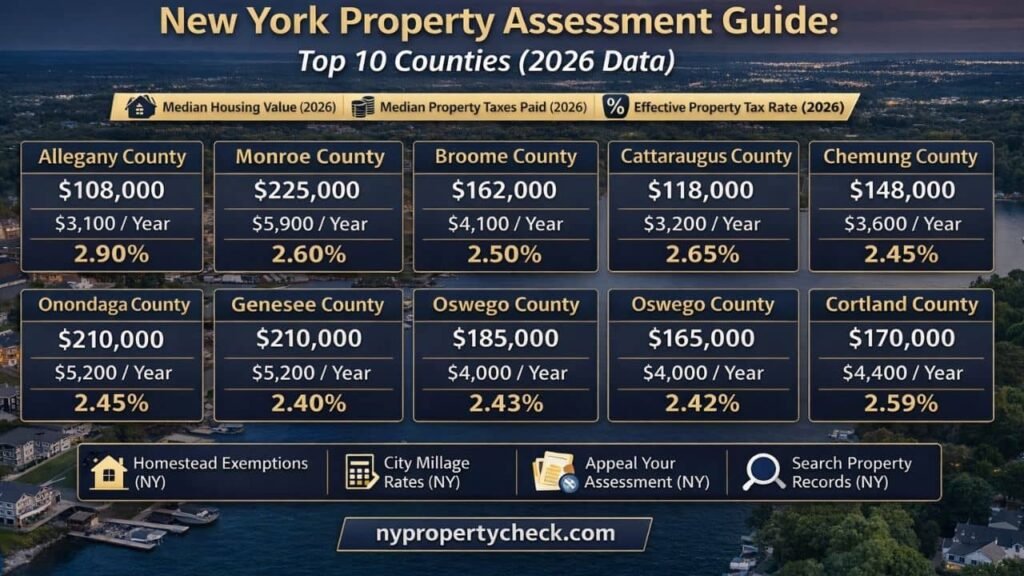
From high-value areas like New York County (Manhattan) to more affordable regions like Allegany County, understanding how assessments work helps homeowners manage costs, claim exemptions, and avoid unexpected tax increases.
How Property Assessments Are Carry Out
In New York, property assessments are managed by local assessors within each county or municipality. These officials estimate a property’s market value, which reflects what the property would likely sell for under normal conditions.
Assessments are based on:
- Recent property sales
- Property size, type, and condition
- Location and neighborhood trends
After determining market value, assessors apply an assessment ratio to calculate the assessed value. Local tax authorities then apply tax rates based on municipal budgets, school districts, and county needs.
Additionally, exemptions such as STAR (School Tax Relief), senior benefits, and veteran exemptions can reduce the taxable value, lowering the final tax bill.
Factors Affecting Property Assessments
Several key elements influence property values and taxes across New York:
- Market Value Changes: Rising home prices increase assessed values and tax bills
- Property Upgrades: Renovations or expansions can raise property value
- Location Differences: Urban counties like Manhattan and Brooklyn differ greatly from rural counties
- Exemptions & Relief Programs: STAR, SCHE, and veteran programs reduce taxable value
- Local Tax Levies: School districts and municipalities heavily influence final tax rates
These factors ensure a fair system while giving property owners opportunities to reduce their tax burden.
County-by-County Property Assessment (Top Counties Overview)
New York County (Manhattan) Property Assessment
New York County (Manhattan) stands at the top with a median home value of $1.12 million, making it the most expensive housing market in the state. Despite this, the effective tax rate is only 0.75%, which helps balance overall tax costs. Median property taxes exceed $10,500, largely influenced by high property demand and premium real estate.
Kings County (Brooklyn) Property Assessment
Kings County features a strong housing market with median home values around $930,000. However, like Manhattan, it benefits from a low effective tax rate of 0.69%, keeping median taxes near $6,500. This makes Brooklyn relatively tax-efficient compared to its high property values.
Nassau County Property Assessment
Nassau County is known for its suburban appeal and high property costs, with median home values reaching $720,000. Property taxes are among the highest in New York, often exceeding $12,500, even with a moderate 1.75% tax rate, due to strong school district funding and local levies.
Queens County Property Assessment
Queens County offers a mix of affordability and urban convenience, with median home values around $750,000. The effective tax rate is 0.85%, keeping median property taxes close to $6,500, making it more balanced compared to nearby boroughs.
Suffolk County Property Assessment
Suffolk County has median property values near $600,000, with taxes exceeding $11,000 annually. The 1.65% effective tax rate reflects suburban growth, infrastructure costs, and school district funding, making it one of the higher-tax regions overall.
Westchester County Property Assessment
Westchester County combines high property values ($690,000 median) with significant tax burdens. Homeowners typically pay over $11,500 in property taxes, with an effective rate of 1.70%, driven by strong local services and proximity to New York City.
Understanding Property Tax Rates in New York
Property taxes in New York depend on multiple layers of government, including:
- County budgets
- City or town services
- School district funding
Unlike many states, New York uses property tax classes, especially in New York City:
- Class 1 (1–3 family homes): 19.843%
- Class 2 (residential buildings): 12.439%
- Class 3 (utilities): 11.108%
- Class 4 (commercial): 10.848%
Each class has different tax rules, which directly impact how much a property owner pays annually.
How to Calculate Your Property Tax in New York
To estimate your annual property tax:
Step 1: Determine market value
Step 2: Apply assessment ratio
- Class 1: 6%
- Other classes: 45%
Step 3: Subtract exemptions (STAR, SCHE, etc.)
Step 4: Multiply taxable value by tax rate
Example Calculation
- Market Value: $450,000
- Assessed Value (6%): $27,000
- Exemption: $3,460
- Taxable Value: $23,540
- Tax Rate: 20.385%
Estimated Annual Tax: $4,798.63
Assessment limits also apply:
- Class 1 increases capped at 6% per year / 20% over 5 years
- Class 2 capped at 8% per year / 30% over 5 years
This prevents sudden spikes in tax bills even when market values rise quickly.
How to Appeal Your Property Assessment in New York
If your property seems overvalued, you can challenge the assessment.
Steps include:
- Review your assessment notice
- Compare similar property sales
- Gather proof (photos, appraisals, reports)
- File a grievance with your local assessor
Each county has its own deadlines, so it’s important to act quickly.
Tools & Resources
- New York County Assessor Offices
- Online property search tools
- Public tax and assessment records
- Market trend and valuation reports
Conclusion
Property assessments in New York vary significantly depending on location, market demand, and local tax policies. Counties like New York (Manhattan), Kings, and Nassau have high property values, while counties like Allegany and Cattaraugus offer more affordable housing but often higher tax rates.
By understanding how assessments work and taking advantage of exemptions such as STAR, homeowners can better manage their property taxes and make informed financial decisions.
FAQs
What is the property assessment process in New York?
Property assessments are conducted by local assessors who estimate market value and apply assessment ratios to determine taxable value.
How are property taxes calculated in New York counties?
Taxes are calculated by multiplying the taxable value by the local tax rate, after applying exemptions.
Which counties have the highest property taxes in New York?
Counties like Nassau, Westchester, and Rockland typically have higher total tax bills due to high property values.
Can homeowners appeal their property assessments?
Yes, property owners can file a grievance with their local assessor and provide supporting evidence.
What exemptions are available in New York?
Common exemptions include STAR, Senior Citizen (SCHE), Veterans, and other local relief programs.